


At this stage your DS8000 should be ready to be used with FCM, for more information on preparing your DS8000 to be used with FCM please go back to Section 3. This section will cover preparing your MS SQL Server for FCM installation. The environment used to prepare this guide as mentioned earlier was running Windows 2003 64-bit SP2 with MS SQL 2005 Server 64-bit SP3. Other versions of Windows & SQL should follow the same path of host preparation & FCM installation, but might require an additional SQL or Windows hotfixes.
This section provides an overview of the installation and configuration of the CIM agent on a Windows 2003 operating system. If you have decided to use the CIM agent for HMC & followed the 3.3 section, then you can skip this section directly to chapter 4. If you are not going to the use the CIM agent for HMC and decided to install the CIM agent on a Windows 2003 host then read on.
Ensure that you know how to administer a Windows 2003 operating system before you install the CIM agent. Also be familiar with the commands that you use during installation and configuration of the CIM agent.
Perform the following list of installation and configuration tasks on your Windows operating system:
Beginning with DS8000 Release 2.4, the CIM Agent is pre-installed on the hardware management console (HMC). This section includes an overview of the setup process and instructions for enabling and configuring the CIM agent on the DS8000 HMC. The DS8000 can be managed either by the CIM agent that is bundled with the HMC or with a separately installed CIM agent. The HMC CIM agent has the following limitations:
- The CIM agent is initially disabled on the HMC and must be enabled through the WebSM management console before it can be used.
- The HMC CIM agent can only support DS8000 devices that are managed by that HMC. This CIM agent is not able to manage any ESS 800 or DS6000 devices, or any DS8000 devices that are managed by a different HMC.
CIM agent is a Common Information Model (CIM) agent provides a means by which a device can be managed by common building blocks rather than proprietary software. If a device is CIM-compliant, software that is also CIM-compliant can manage the device.
Vendor applications can benefit from adopting the common information model because they can manage CIM-compliant devices in a common way, rather than using device-specific programming interfaces. Using CIM, you can perform tasks in a consistent manner across devices and vendor applications.
This task creates the free volume pool (VSS_FREE Volume Group) and the reserved volume pool (VSS_RESERVED Volume Group) that are used to assign volumes to the virtual host. Before you can use the IBM System Storage support for Microsoft Volume Shadow Copy Service and Virtual Disk Service software, you must specify the volumes that can be used as FlashCopy target volumes. You specify the volumes after you create a VSS_FREE pool and a VSS_RESERVED pool. These pools are represented by virtual hosts that are created on the storage unit. After the virtual hosts are created, you can add volumes to the free pool by assigning a volume to the virtual host. Perform the following steps using the IBM System Storage DS Storage Manager or DS CLI to create the VSS_FREE and VSS_RESERVED pools:
Before even reaching to your IBM Tivoli Flash Copy Manager installation CDs, there are few preparation steps that must be carried out on the DS8100 & any SQL Server where you will install IBM FCM in our case SQLnode01_POC, SQLnode02_POC, & SQLsrv01_POC. Please note for the integration of IBM Tivoli Storage Manager with IBM Tivoli Flash Copy Manger, IBM TSM has to be separately installed & configured, though TSM installation is out of this book scope. Though if you have an IBM Tivoli Storage Manager already setup in your environment, you will be able to integrate IBM FlashCopy manager with it easily by running through the Wizard illustrated in later chapters. In this chapter we will focus on the DS8100 preparation for IBM Tivoli FlashCopy Manager Installation.
IBM Tivoli Storage FlashCopy Manager for SQL can be used in many different combinations of different versions of Windows, different versions of SQL, as well many different combinations of hardware. In order to cover the full details of installing & configuring IBM Tivoli Storage FlashCopy Manager for SQL in DS8000 enviornment, the setup showing in figure 2-1 & explained below will be assumed in further chapters.
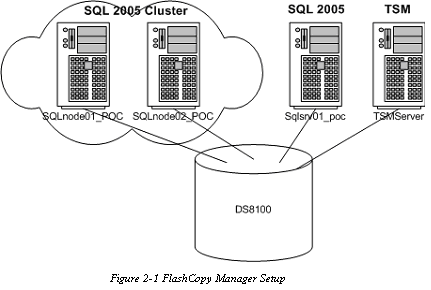
- SQLnode01_POC:
SQLnode01_POC is a System X machine running Windows 2003 64-bit SP2. It’s the first node of SQL 2005 64-bit SP3 cluster.
- SQLnode02_POC:
SQLnode02_POC is a System X machine running Windows 2003 64-bit SP2. It’s the second node of SQL 2005 SP3 cluster.
Before you install Tivoli Storage FlashCopy Manager, ensure your system meets the minimum hardware, software and operating system requirements. Review the following prerequisite information before attempting to perform any installation tasks.
_Minimum hardware requirements
Table 2.1 Minimum hardware requirements:
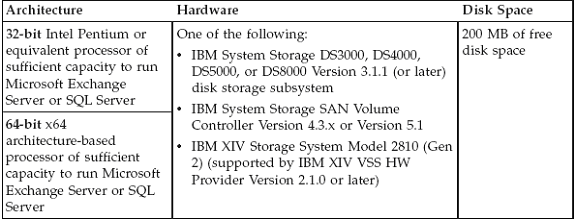
Note: Tivoli Storage FlashCopy Manager also supports hardware that is required when using the Windows System Provider or a Microsoft-compliant software or hardware VSS Provider.
– In order to use the hardware provider provided by IBM Storage, you will have to obtain the optional FlashCopy License for your storage. FlashCopy feature on your storage must be enabled prior to using your IBM storage hardware provider. For more information about enabling FlashCopy on your IBM Storage please refer to your storage documentation.
The Tivoli Storage FlashCopy Manager integrates with Microsoft VSS – Volume Shadow Copy Services – to protect MS SQL Server databases & logs. Tivoli FlashCopy manager help you back up and restore data to and from local shadow volumes with automated tasks, utilities, and interfaces.
_Microsoft Volume Shadow Copy Services – MS VSS Service
The Microsoft Volume Shadow Copy Service (VSS) is a Microsoft component that is provided with the Windows operating system. VSS manages and directs the Tivoli Storage FlashCopy Manager VSS requestor and other VSS software applications.
In today’s business world, where application servers are operational 24 hours a day, the data on these servers must be fully protected. You can’t afford to lose any data, but you also can’t afford to stop these critical systems for hours so you can protect the data adequately.As the amount of data that needs protecting continues to grow exponentially and the need to keep the downtime associated with backup to an absolute minimum, IT processes are at their breaking point.


